SBA Loan Refinance of MCA Positions Under SOP 50 10 8.1: A Playbook for Funders and Brokers
SOP 50 10 8.1 lets SBA loans refinance converted MCA positions after 24 months. The three conditions, open questions and what to document.
Playbook · · 6 min read
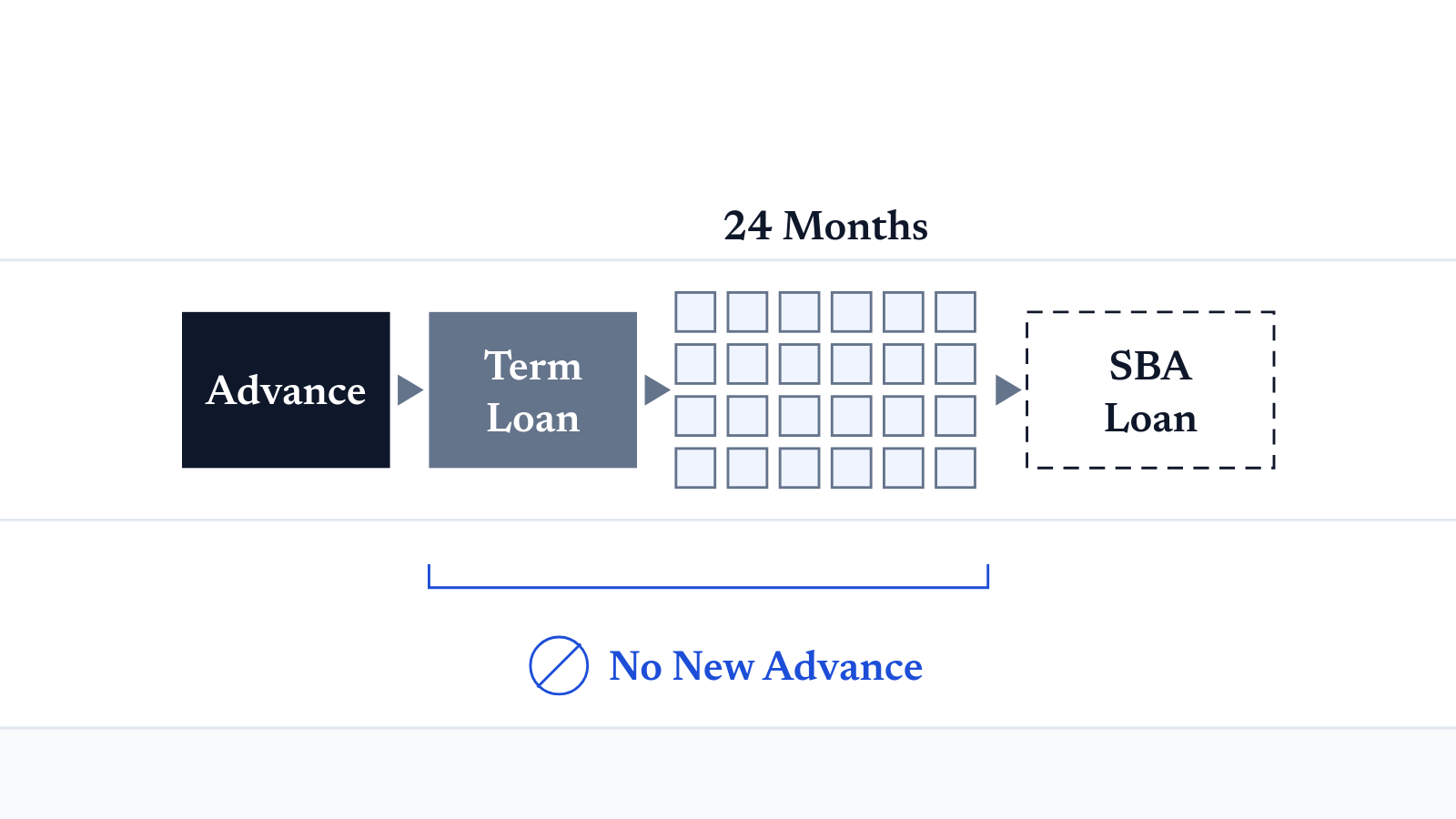
SOP 50 10 8.1 took effect on October 1, 2026, and it reopens SBA refinancing to merchant cash advance positions. The opening is narrow. A position becomes eligible only after it has been converted to a term loan and amortized for at least two years with no new agreements layered on top. Almost no merchant qualifies today. The change matters more for how funders and ISOs structure positions now than for any deal that closes this quarter.
By the numbers
- 3: conditions a sales-based position must meet before SBA proceeds can refinance it (SOP 50 10 8.1, sba.gov, effective Oct 1, 2026)
- 24 months: the minimum amortization required after conversion (SOP 50 10 8.1, sba.gov, effective Oct 1, 2026)
- 29 days: the longest a required payment can go unpaid while the debt still counts as current (SOP 50 10 8.1, sba.gov, effective Oct 1, 2026)
- 12 months: the lookback period for current status, or the life of the debt if that is shorter (SOP 50 10 8.1, sba.gov, effective Oct 1, 2026)
- Jun 1, 2025 to Sep 30, 2026: the period when SOP 50 10 8 barred MCA refinancing outright (sba.gov)
From exclusion to conditional path
| SOP 50 10 8 | SOP 50 10 8.1 | |
|---|---|---|
| Effective | June 1, 2025 | October 1, 2026 |
| Treatment of MCAs | Not eligible for refinancing | Eligible only if converted, amortized 24+ months, with no new agreements |
| Factoring | Named alongside MCAs as not eligible | Not addressed in the sales-based passage; status unconfirmed |
| Terminology | “Merchant cash advances” | “Sales-Based Repayment Agreements” |
SBA announced SOP 50 10 8 on April 21, 2025, in Information Notice 5000-866746, according to Grasshopper Bank’s lender commentary. Great Lakes Commercial Finance dates the release to April 22, 2025. The SOP replaced 50 10 7.1 on June 1, 2025, for applications assigned a loan number on or after that date. Its exclusion was a single sentence: “Merchant cash advances and factoring agreements are not eligible for refinancing.”
The 8.1 text, which sba.gov now lists as “Version 8.1 with Technical Updates,” moves to functional language. It defines a Sales-Based Repayment Agreement as “a business funding agreement where a business receives a cash advance in exchange for a percentage of its future sales.” That definition fits the standard MCA structure, a purchase of future receivables, without SBA taking a position on how courts characterize those contracts. That question remains unsettled. deBanked first reported the change on September 23, 2026.
The three conditions, read as an eligibility screen
All three conditions must hold at the time of the SBA application.
1. The original agreement has been converted to a term loan. The SOP does not say who has to perform the conversion. It is not yet known whether a funder converting its own advance into a term product satisfies the condition, or whether a third-party lender must take out the position. Until that is clarified, assume the SBA lender will look closely at the conversion document itself. It should read as a term loan, with a fixed amortization schedule, and not as a restated purchase agreement.
2. The converted debt has amortized for at least 24 months. The text does not state the start date. It has not been confirmed whether the clock runs from the conversion date, or whether every payment in that window has to be on time. The currency test below answers part of the second question in practice.
3. No additional agreements since the conversion. This is the condition most likely to collide with standard renewal practice. The passage contains no carve-out for renewals. Read plainly, a renewal, top-up or stacked position written after conversion looks like an “additional Agreement.” Treat that as an interpretation to confirm with the SBA lender, not as settled guidance.
The SOP also closes off the obvious workaround: “If the Sales-Based Repayment Agreement is still active, it is not eligible for refinancing.”
The currency test sits on top
Any debt refinanced with SBA proceeds must also meet 8.1’s general currency standard:
- “Current” means no required payment has stayed unpaid for more than 29 days.
- Debt that matured and was not paid off within 29 days of maturity is not current and cannot be refinanced.
- The debt must be current now, and must have been current for at least the last 12 months or for its full life, whichever is shorter.
For a converted position, the 12-month lookback falls entirely inside the 24-month amortization window. Servicing records for the second year of the term loan will therefore carry the most weight.
Program scope
deBanked reported that SOP 50 10 8’s exclusion applied to Standard 7(a), 7(a) Small, SBA Express, Export Express and International Trade loans. We have not confirmed whether 8.1’s conditional path applies to exactly that same list. Whether the condition reaches 504 debt refinancing is also unconfirmed.
Implications for funders
- Conversion design. A funder offering a term conversion as an SBA bridge needs documentation that an SBA lender will accept as a term loan. That means a dated conversion, a fixed schedule and amortizing payments. Whether a self-conversion qualifies at all is still open.
- Renewal programs. A merchant on the conversion track has to stay out of the renewal pipeline for at least two years, or the SBA exit is lost. Funders that rely on renewals should decide which merchants they will steer toward conversion and which they will keep on renewal terms.
- Servicing records. The currency test turns the payment ledger into eligibility evidence. Records should show each payment date against its due date.
Implications for brokers and ISOs
- Build the file around the conditions. The SOP does not prescribe a document list. Still, a credit memo will have to address each condition, so a broker can prepare the following: the executed conversion agreement and its date, the amortization schedule, a payment history covering at least 24 months that shows no payment unpaid beyond 29 days, and confirmation that the merchant has signed no new sales-based agreement since conversion.
- Pipeline timing. Merchants placed into term conversions in October 2026 become SBA refinance candidates in late 2028 at the earliest. Anyone marketing this exit should present it as a two-year program, not a near-term takeout.
- Eligibility is not approval. Meeting the three conditions only makes the debt eligible for refinancing. The SBA lender still underwrites the application. An SBA loan is also not the right fit for every merchant.
Outside the SBA program
Renaissance Capital Advisors notes (about May 2026) that a conventional bank loan without an SBA guarantee can still refinance MCA balances at the bank’s discretion, usually with tighter underwriting. Treat that as context from advisor commentary, not as a rule.
Still unresolved
- Whether 8.1 gives factoring agreements the same conditional path, or limits it to sales-based repayment agreements.
- Whether the 24 months run from the conversion date, and whether every payment in that window must have been on time.
- Whether the condition applies to 504 debt refinancing as well as 7(a).
- What payment-improvement or “unreasonable terms” test 8.1 applies to 7(a) debt refinancing, if any. Coleman Report has described an installment-improvement test, but no such figure appeared in the 8.1 text when it was checked on October 19, 2026. Do not build structures around a specific threshold.
Sources
- U.S. Small Business Administration, SOP 50 10: Lender and Development Company Loan Programs (version 8, effective June 1, 2025; version 8.1 with Technical Updates, effective October 1, 2026): https://legacy.sba.gov/document/sop-50-10-lender-development-company-loan-programs
- deBanked, “How to Pay Off an MCA With an SBA Under the New Rules Effective Oct 1”, September 23, 2026: https://debanked.com/2026/09/how-to-pay-off-an-mca-with-an-sba-under-the-new-rules-effective-oct-1/
- deBanked, “SBA Places Restrictions on Use of Proceeds to Refinance Merchant Cash Advances and Factoring Agreements”, about April 22, 2025: https://debanked.com/2025/04/sba-places-restrictions-on-use-of-proceeds-to-refinance-merchant-cash-advances-and-factoring-agreements/
- Grasshopper Bank, “New SBA SOP: What You Need to Know About 50 10 8”, indexed about March 2026: https://www.grasshopper.bank/who-we-are/blog/new-sba-sop-what-you-need-to-know-about-50-10-8/
- Great Lakes Commercial Finance, “Changes Ahead: What the New SOP 50 10 8 Means for You”, 2025 (date not given): https://glcf.org/changes-ahead-what-the-new-sop-50-10-8-means-for-you/
- Coleman Report, “Clarification of SBA 7(a) Rules: Change of Ownership and Debt Refinance”, about July 2025: https://colemanreport.com/clarification-of-sba-7a-rules-change-of-ownership-and-debt-refinance/
- Renaissance Capital Advisors, SBA MCA refinancing commentary, about May 2026: https://rencapadvisors.com/insights/sba-mca-refinancing-closed.html